The person behind the work.
Personality. Experiences. Convictions.
01
A life between experience and insight.
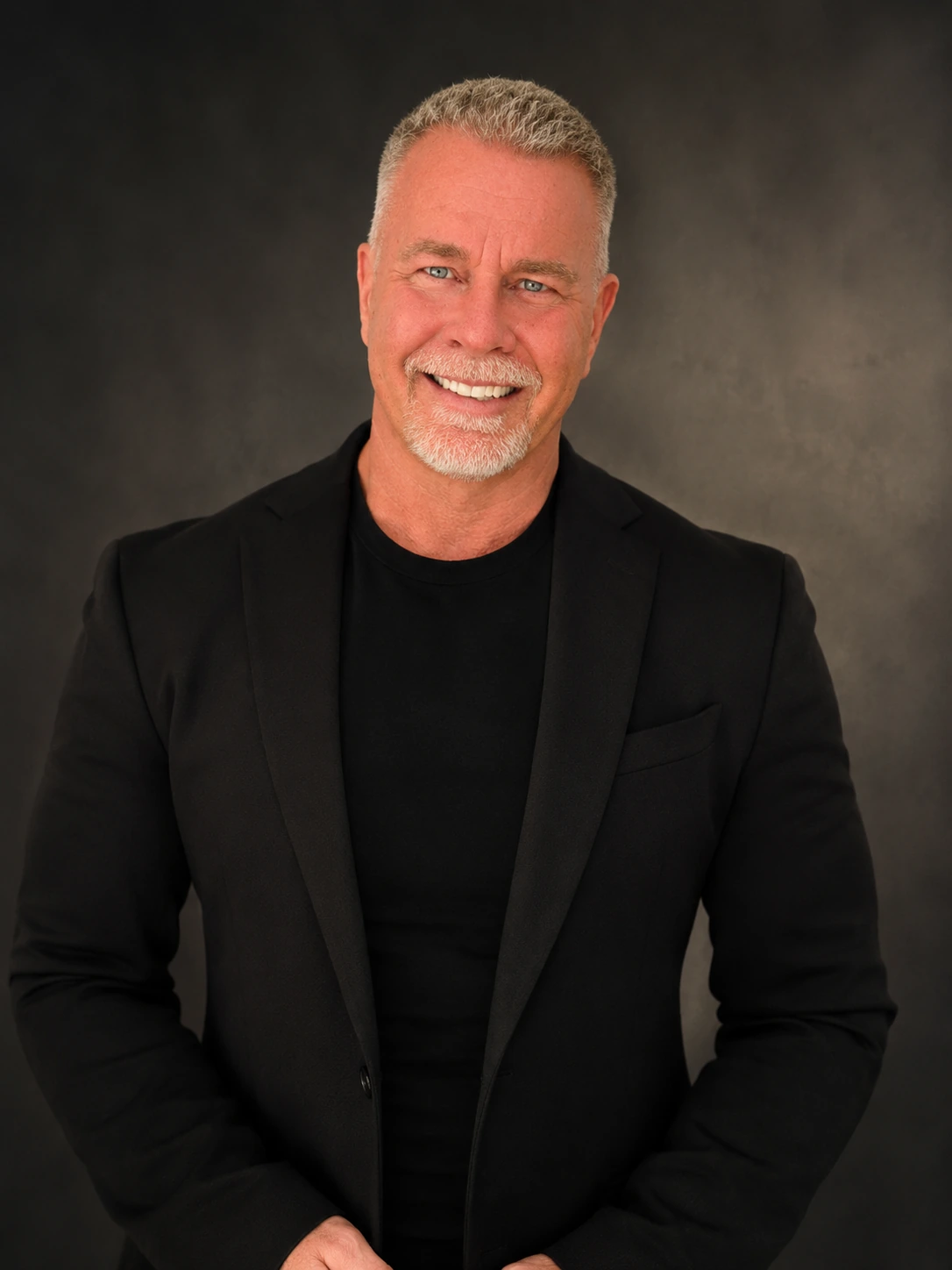
At first, my professional path gave little indication of what would later come to define my life.
After finishing secondary school and abandoning my first apprenticeship, I trained as a food retail salesman at my parents’ insistence.
An encounter with a financial adviser eventually opened up an entirely different professional perspective. I decided to become self-employed and, within three years, built a sales organisation of more than 800 people.
By the age of 21, I already carried considerable entrepreneurial responsibility. I had learned to lead people neither from books nor in seminars. What shaped me during that time was my daily engagement with people, my observations and my intuitive understanding of human behaviour.
I could not yet have guessed that this very engagement with human beings would become the central element of the rest of my life.
02
The encounter that changed my perception.
Through Hubert Müller, my regional director at the time, I met Brigitte Boldt when I was 21.
This encounter became one of the most significant turning points of my life.
Over a period of three years, we held regular, intensive personal conversations in which I began to engage with human existence on an entirely different level.
What initially touched on subjects such as positive thinking and personal development led me increasingly towards far more fundamental questions.
What is a human being in the first place? What distinguishes consciousness from the mind and from the biological body? How does our personal reality come into being, and what influence do we ourselves have on what we experience?
While I continued to carry entrepreneurial responsibility, I began to integrate these insights into my everyday life and into my work with people.
A connection emerged between two fields that, at first glance, seemed to have little in common: economic activity and the understanding of human existence.
03
From insight to application.
An existential economic crisis eventually forced me to fundamentally rethink the professional path I had followed until then.
What I had built up to that point could no longer be taken for granted. At the same time, I realised that the insights of the past years could only unfold their true value if they also held up under difficult living conditions.
I reoriented myself professionally. Alongside further entrepreneurial activities, direct work with people increasingly became an independent part of my work.
I began to accompany people through personal processes of change, gave talks and engaged ever more intensively with the interactions between consciousness, psyche and the biological body.
Under the title “The World We Could Live In”, I was already conveying perspectives at that time that went far beyond conventional motivation and personal development.
Psychosomatics in particular opened up a further approach to understanding human interrelations for me.
I was concerned not only with the question of which symptoms a person develops, but also with which personal experiences, inner conflicts and patterns of perception might be connected with them.
At the same time, practical work with people became an ongoing opportunity for me to question my own convictions, to view connections in a more nuanced way and to keep developing my understanding.
04
From application to creation.
Over the decades, this gave rise to a growing wish not to pass on my insights solely in personal conversations.
I began to develop my own concepts, to record connections in writing and to make my perspectives accessible to a wider circle of people.
This gave rise to books, philosophical works and independent projects.
With The System Code, I formulated essential aspects of my understanding of human existence, consciousness and personal reality in one coherent work.
Other publications deal with human relationships, social developments, identity and personal responsibility.
At the same time, I remained an entrepreneur.
In developing products and innovations, too, it was always decisive for me to question existing connections rather than simply adopting existing solutions.
Whether a philosophical work, an entrepreneurial project or a product development – for me, it always begins with the same question:
Why is something the way it is? And does it really have to stay that way?
05
Experiencing my own limits.
It would be wrong, however, to portray my life solely as a continuous development of insight and success.
I, too, have made decisions whose consequences forced me to rethink my entire life up to that point and the path ahead of me.
I have experienced economic success, built companies and accompanied people. Equally, I have suffered losses, made mistakes and had to recognise that even an extensive understanding of human interrelations does not protect me from making wrong decisions myself.
Between recognising a truth and consistently putting that insight into practice in one’s own life, there is often a considerable difference.
Precisely for this reason, I do not see myself as someone who meets others from a position of perfection.
I am myself part of what I have been exploring for nearly four decades.
06
The person beyond the public role.
Amid all my entrepreneurial activities, my work with people and my engagement with philosophical questions, there is one area of my life that holds special meaning for me: my family.
Being the father of my three sons, Kevin, Nico and Kuba, is one of the most precious tasks of my life.
I am convinced that a father bears a special responsibility for the development of his sons. To me, his task is not only to convey values to them, but also to live out for them what it means to be a man.
This includes a sense of responsibility, empathy, determination, purposefulness and assertiveness. The ability to make decisions, to bear their consequences and to stand by one’s convictions even under difficult circumstances.
For me, however, male strength does not show itself solely in the ability to assert oneself. It shows itself just as much in the ability to take responsibility for others, to feel compassion, to admit one’s own mistakes and to yield where it is humanly called for.
I never saw my task as a father as turning my sons into copies of my own personality. Rather, I wanted to give them a foundation on which they could develop their own identity and shape their lives on their own responsibility.
That, in the course of their development, they form their own views, judge things differently and make different decisions is, for me, a natural part of this process.
A father can give his sons orientation. Ultimately, they must walk their path themselves.
It is within a family above all that it becomes clear to what extent a person is truly willing to live the values they represent to the outside world.
Love, loyalty, trust and responsibility are not abstract concepts. Their true meaning becomes apparent especially when life does not match one’s own expectations.
Of everything I have built, developed or achieved in my life, there is one insight that holds special meaning for me:
Public recognition and personal fulfilment are two entirely different things.
The one can never replace the other.
07
What defines me today.
At 60, I look back on a life shaped by very different experiences.
Entrepreneur, author, developer and human being – for me, these are not separate identities.
They are different expressions of my personality.
For me, a person’s worth is measured neither by their wealth nor by their social standing, nor by the public recognition they receive.
Charity, humility, loyalty, sincerity and the willingness to take responsibility for one’s own actions are far more important to me.
This also includes the willingness to question oneself and to acknowledge that one’s own perception need not necessarily be another person’s truth.
I do not claim to know all the answers.
But to this day, I have never stopped asking questions.
Always ask why first.
Frank aus der Wieschen