
Behind the visible.
Consciousness & Insight.
What is a human being in the first place?
For almost four decades I have been occupied with a question that, for me, reaches far beyond an understanding of human behaviour.
What is a human being, independent of what they have learned, what they own, what they have experienced and what they believe themselves to be?
We study the workings of the human body intensively. We examine the mind, analyse patterns of behaviour and try to understand human emotions.
But do we thereby truly explain the human being itself – or merely the workings of what is at its disposal?
01
The fundamental question of our existence.
When a person speaks of their body, they say: my body.
When they speak of their thoughts, they say: my thoughts.
When they speak of their memories, their emotions or their mind, they likewise use a linguistic distinction between themselves and what they are speaking about.
But who is this I that speaks of all these things as its possession or its experience?
Who perceives?
Who observes one's own thoughts?
Who decides which thoughts are given meaning?
At the centre of my philosophical understanding lies a fundamental conviction:
A human being does not have consciousness. A human being is consciousness.
This distinction fundamentally changes the perspective on human existence.
02
Consciousness, mind and the biological body.
In my understanding, consciousness, the mind and the biological body are not to be equated.
The biological body enables us to have experiences within this physical reality.
The mind processes information, stores experiences, recognises connections, develops strategies and tries to assess future events on the basis of information already available.
It is an extraordinarily complex instrument.
But an instrument is not necessarily identical with the one who uses it.
I understand consciousness as the true creative essence of the human being. The will enables a person to make decisions and to choose between different possibilities.
The mind can support these decisions. Yet it can equally influence them through stored experiences, fears and learned beliefs.
For me, therefore, the decisive question is not solely how capable our mind is.
Rather, the question is in what relationship we stand to it.
Is the mind our instrument – or has it come to determine who we believe ourselves to be?

03
How identification arises.
A human being comes into a world in which ideas, social structures, standards of value and expectations already exist.
From the very beginning they are confronted with information that shapes their understanding of themselves and their surroundings.
They receive a name. They develop a sense of belonging. They learn what is regarded as right or wrong, successful or unsuccessful, desirable or undesirable.
Over the course of their life, this gives rise to an ever more complex image of their own personality.
Yet this image is made up to a considerable extent of experiences, judgements and adopted beliefs.
The human being begins to identify with what they have experienced, learned and assumed about themselves.
They may increasingly mistake their identification for their actual existence.
For me, a fundamental insight begins where a person is willing to distinguish between what they are and what they believe themselves to be.
04
Perception and personal reality.
Two people can experience the same situation and still arrive at completely different insights.
Not necessarily because one of them knows the truth and the other is mistaken, but because both view what they experience through different experiences, beliefs and expectations.
Our perception is not independent of our personal history.
What represents a threat to one person can be an opportunity for another.
What one experiences as a loss, another may regard as the beginning of a new development.
The external circumstances may be identical. The personal reality that arises from them can nevertheless differ considerably.
This does not mean that objective facts are arbitrary.
Rather, it means that our individual experience of these facts is substantially influenced by how we perceive, interpret and evaluate them.
We do not only experience what happens. We also experience the meaning we give to what happens.

05
Remembrance instead of development.
The term personal development is almost omnipresent today.
Yet perhaps this very term already contains an assumption worth questioning.
Must a human being really first become something in order to recognise their true existence?
Or does the more essential task lie in becoming aware once again of what they already are?
In my philosophical understanding, the human being has not lost their true essence.
Rather, they have lost awareness of it.
For me, insight therefore does not solely mean acquiring new knowledge.
It can equally mean letting go of adopted ideas and remembering something that has increasingly receded into the background through identification and conditioning.
Perhaps the most profound development of a human being lies not in becoming someone else, but in remembering who they are.
06
Freedom and responsibility.
For me, freedom does not mean being able to control all external circumstances.
A human being encounters situations, developments and events over which they have no direct influence.
But within their possibilities they can decide how they meet them, what meaning they give them and what consequences they draw from them for their further actions.
This freedom of choice is inseparably bound up with responsibility.
Personal responsibility does not mean holding oneself responsible or guilty for every event.
It means recognising one's own possibilities for action and dealing with them consciously.
Insight alone does not yet change a life.
Only where insight turns into decisions and actions can it unfold its true meaning.

07
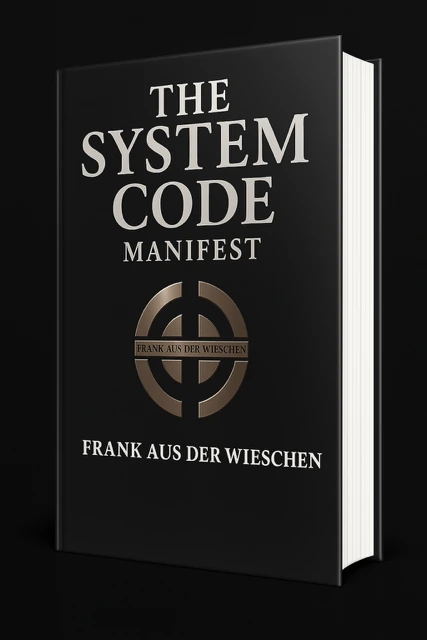
THE SYSTEM CODE.
Consciousness vs. Illusion.
With THE SYSTEM CODE I have formulated essential aspects of my philosophical understanding in one coherent work.
At its centre lies the distinction between three fundamental terms:
- THE SYSTEM
- The external structures, rules, social orders and conditions within which human life takes place.
- THE MATRIX
- The inner programming of the human being through experiences, conditioning, beliefs and identification.
- THE CODE
- The key to recognising these connections and to consciously engaging with one's own limitations.
THE SYSTEM CODE is not a call to reject every social structure.
It is an invitation to recognise which structures influence our thinking and acting, and to what extent we are aware of their effect.
The work does not claim to answer all questions of human existence conclusively.
It encourages us to ask questions we may never have asked before.
Discover THE SYSTEM CODEI do not want to tell people what they should think.
I want to encourage them to question why they think what they think.
Always ask why first.
Frank aus der Wieschen